June 1, 2026 • Mara Voss • 9 min reading time • Prices verified June 5, 2026
Tungsten Inlay Bands: Decoding Koa Wood, Carbon Fiber, and Meteorite Before You Buy
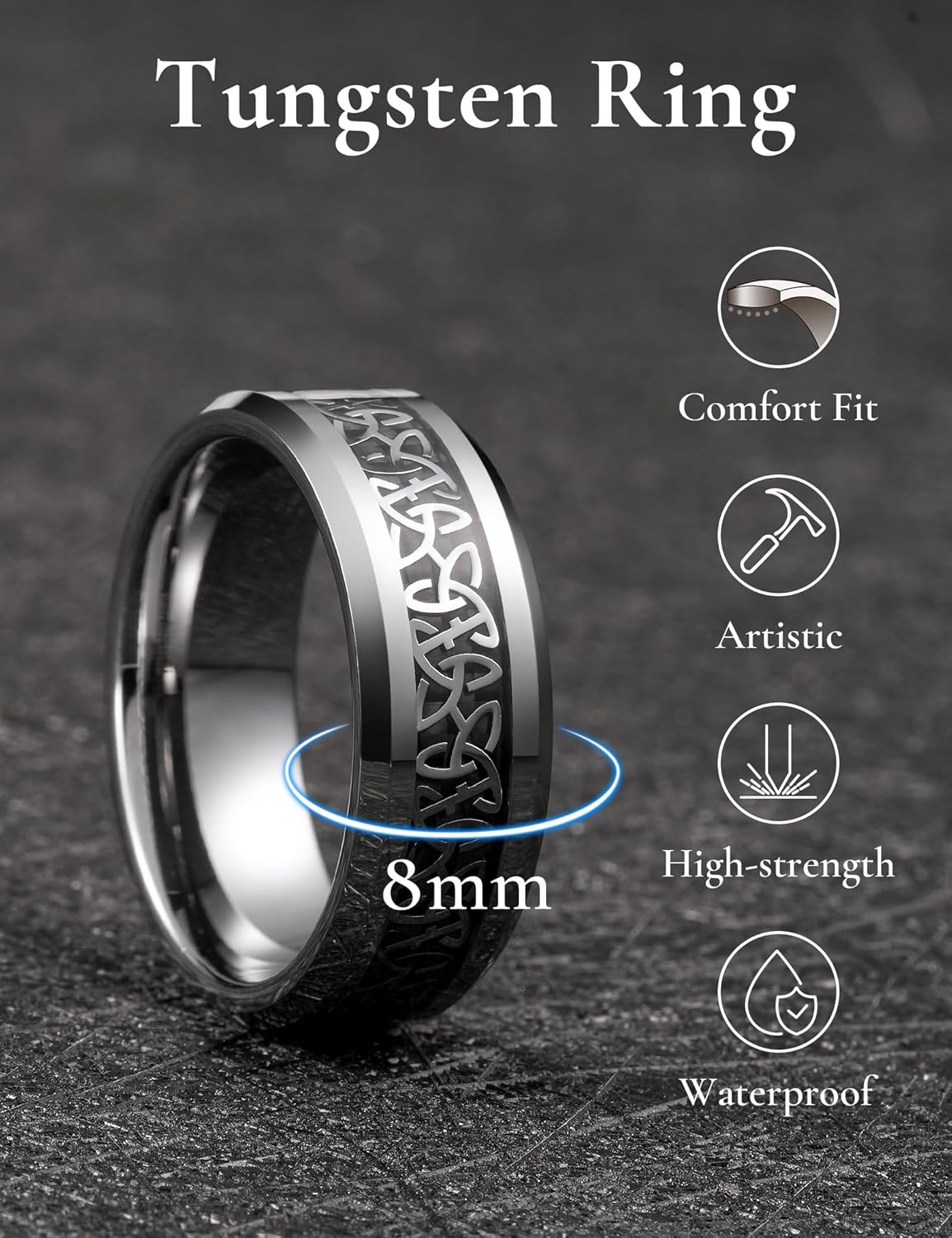
Tungsten carbide — a compound of tungsten metal and carbon fused at extreme heat into one of the hardest materials used in jewelry — has become one of the most popular wedding band choices for people who want a ring that shrugs off daily abuse. Its defining characteristic: it sits at roughly 9 on the Mohs hardness scale (a 1–10 measure of a material’s scratch resistance, where diamond is 10 and gold hovers around 2.5–3). The catch is that tungsten carbide is also brittle — it won’t bend under pressure the way gold does; it shatters. That’s the trade-off you carry into every buying decision that follows.
Inlay bands add a second layer to that decision. An inlay is a strip of decorative material — wood, carbon fiber, meteorite, opal, and more — set into a channel routed from the ring’s face. You’re buying two materials, two sets of durability rules, and two separate maintenance contracts in a single piece. This guide decodes the three most popular inlay categories, names the real failure modes, shows you the math that matters, and closes with a clear decision framework so you can stop second-guessing and commit.
| EDITOR'S PICK[100S JEWELRY Gunmetal Tungsten…](https://www.amazon.com/dp/B08NC8JPS4?tag=greenflower20-20) | Mid-tierKing Will Men's Celtic Claddagh… | Budget pick[King Will 8mm Mens Tungsten Wed…](https://www.amazon.com/dp/B00LEBZ55O?tag=greenflower20-20) | |
|---|---|---|---|
| Inlay material | Koa wood | Opal/Carbon fiber | Carbon fiber plaid |
| Ring width | — | 8mm | 8mm |
| Ring style | Thin blue line | Celtic Claddagh | Plaid |
| Fit type | — | Comfort fit | — |
| Metal finish | Gunmetal | — | Polished silver-black |
| Price | $49.99 | $34.99 | $27.99 |
| See on Amazon → | See on Amazon → | See on Amazon → |
The Tungsten Shell: What You’re Actually Getting as a Base
Before the inlay conversation starts, the base metal deserves a clear-eyed read — because it shapes everything downstream.
Tungsten carbide bands spec’d for jewelry are typically cobalt-free (an important note: cobalt-bonded tungsten can cause skin reactions in nickel-sensitive wearers; reputable retailers like Lashbrook and Benchmark specify cobalt-free, nickel-free formulations). The Gemological Institute of America’s overview of tungsten carbide jewelry properties confirms a Vickers hardness in the range of 1,200–1,400 HV — roughly three times harder than titanium and seven to eight times harder than 14k gold. That number means virtually no surface scratching from everyday contact.
The brittleness factor is real and worth stating plainly: if a tungsten band receives a sharp lateral impact — a dropped wrench, a concrete edge — it can crack or shatter rather than deform. Emergency responders can remove a cracked tungsten ring with standard vice-grip tools, which is why most surgeons and first responders are not advised against tungsten categorically, but it’s a conversation worth having with your jeweler.
Sizing is also permanently off the table. Tungsten cannot be resized; exchanges are the only path to a new size. The Knot’s 2025 Wedding Ring Trends Report notes that sizing exchanges are the single most common post-purchase issue with alternative metal bands — build this into your retailer selection. Lashbrook’s lifetime sizing exchange program and Benchmark’s comfort fit guarantee are worth reading in full before checkout.
Koa Wood Inlay: The Warmth Trade-Off
Koa is a Hawaiian hardwood (Acacia koa) prized for its ribbon-grain figure and warm amber-to-mahogany color range. It’s the most popular organic inlay in tungsten bands, and it’s also the most maintenance-intensive of the three inlay types in this guide.
What reviewers and owners consistently report: Koa inlay is visually stunning out of the box — the grain figuring under tungsten’s polished edge creates a contrast that photographs exceptionally well. But wood is organic and porous. Owners of koa inlay bands across aggregated reviews on specialty sites like Lashbrook’s customer gallery and third-party review platforms consistently flag two issues: color shift and edge wear.
Color shift happens gradually. Koa deepens over time with UV exposure and skin oil contact — some wearers love this, some don’t. Edge wear is the harder problem: the transition point between the tungsten shoulder and the wood channel is where micro-lifting and chipping begins, particularly for wearers in trades or outdoor work with frequent glove-on, glove-off cycles.
Maintenance reality: Most manufacturers ship koa inlay bands with instructions to apply a light coat of mineral oil or ring-specific wood conditioner every few months. Jewelers Mutual’s Ring Care and Loss Prevention Guide notes that organic inlay materials are among the most frequently submitted for insurance claims involving cosmetic damage — worth factoring into your coverage conversation.
Who it’s right for: Desk workers, professionals in climate-controlled environments, and buyers for whom the visual story matters more than maximum durability. Budget $15–25/year for maintenance products and plan for occasional professional re-sealing if you wear the ring in water frequently.
Who should look elsewhere: Surgeons, construction workers, landscapers, or anyone whose ring spends significant time in water, soil, chemicals, or under gloves.
Carbon Fiber Inlay: The Durability Leader
Carbon fiber in ring inlay context is a woven composite — strands of carbon atoms bonded in a polymer matrix, arranged in a characteristic diagonal weave pattern. It reads visually as a dark, textured surface with a subtle geometric pattern. National Jeweler’s feature on specialty inlay materials in men’s bands describes carbon fiber as the inlay material with the best track record for dimensional stability, noting its resistance to moisture, UV exposure, and temperature cycling that degrades organic materials.
The numbers that matter:
| Inlay Material | Moisture Resistance | UV Stability | Edge Durability | Maintenance Frequency |
|---|---|---|---|---|
| Koa Wood | Low | Moderate | Moderate | Every 2–4 months |
| Carbon Fiber | High | High | High | Annual inspection |
| Meteorite | Moderate | High | High | Every 1–3 months |
Ratings based on manufacturer care documentation and aggregated owner reporting. Not lab-tested by this publication.
Carbon fiber’s failure mode is different from wood’s. Rather than chipping at edges, carbon fiber inlays can delaminate — the composite separates from the adhesive bond in the channel — if the ring is exposed to repeated thermal shock (think: moving from freezer work to hot industrial equipment repeatedly). JCK Online’s 2025 Alternative Metals Market Report notes that delamination claims are rare but concentrated in food-service and industrial-kitchen environments. For most wearers, carbon fiber is effectively maintenance-free.
The aesthetic trade-off: Carbon fiber is dark, industrial, and cool — it pairs exceptionally well with black tungsten (ion-plated in a black PVD coating, which adds a thin decorative layer to the band’s surface) or gunmetal tungsten. If you want warmth or organic character, it won’t deliver that. Brands like Triton offer carbon fiber inlay tungsten sets in the $120–$180 range; Lashbrook’s hand-finished versions run $350–$500+ with custom weave orientation options.
Who it’s right for: Active-lifestyle buyers, trades workers, athletes, anyone who wants the inlay aesthetic without the maintenance overhead. It’s the inlay for people who want to forget the ring exists.
Meteorite Inlay: The Provenance Premium
Meteorite inlay uses actual extraterrestrial iron-nickel alloy — most commonly sourced from the Gibeon meteorite field in Namibia or the Muonionalusta meteorite from Sweden — sliced thin, treated with acid to reveal the distinctive Widmanstätten crystalline pattern (a geometric cross-hatch structure that forms over billions of years of slow cooling in space, impossible to replicate synthetically). That pattern is the entire visual proposition: no two sections are identical.
Here’s the trade-off most buyers aren’t told clearly enough: meteorite contains iron, and iron rusts. The acid-etching treatment that reveals the pattern also opens microscopic surface texture that traps moisture. Without regular oiling with a rust-inhibiting product — most manufacturers recommend Renaissance Wax or a thin application of mineral oil — meteorite inlay will develop rust spotting within months in humid environments or with regular water exposure.
Lashbrook’s meteorite care documentation, which National Jeweler has cited in coverage of specialty band materials, recommends monthly maintenance for active wearers and quarterly for light-use wearers. This is not a ring for someone who wants to ignore maintenance.
The nickel disclosure matter: Gibeon and Muonionalusta meteorite both contain nickel — typically 7–10% by composition. Nickel is the most common contact allergen in jewelry. The Gemological Institute of America’s guidance on alternative metals notes that nickel release rates in meteorite are lower than in nickel-bonded tungsten, but individuals with documented nickel sensitivity should patch-test or consult a dermatologist before committing to meteorite inlay worn against skin. Reputable retailers disclose this; if the product listing doesn’t mention nickel content, ask before purchasing.
Provenance and pricing: Meteorite supply is finite — Gibeon meteorite exportation has been restricted by Namibian law since 2004, meaning supply in the market is from pre-restriction stockpiles. JCK Online’s market coverage notes that Gibeon prices at the raw material level have increased roughly 40% over the past decade as accessible stockpiles thin. Expect to pay $250–$600+ for meteorite inlay tungsten from quality retailers like Brilliant Earth or Lashbrook, with bespoke options exceeding $800.
Who it’s right for: The buyer for whom the story matters as much as the object — someone who wants to wear something genuinely ancient and unrepeatable, understands the maintenance commitment, and isn’t nickel-sensitive. It’s the inlay for the design-forward buyer who will actually do the monthly oil.
Who should look elsewhere: Anyone who describes themselves as “low-maintenance” about jewelry care. The maintenance gap between meteorite and carbon fiber is real, and ignoring it produces a ring that looks neglected within a year.
If X, Then Y: The Decision Framework
You’ve now got the full trade-off map. Here’s the decision rule, stated plainly:
If your hands are in water, soil, or gloves daily → carbon fiber, no hesitation. It’s the only inlay in this group that forgives occupational abuse without returning the bill later.
If aesthetics are your primary driver and you work at a desk → koa wood for warmth and organic character, meteorite for drama and provenance. Accept the maintenance schedule as part of ownership, and factor ring insurance into your budget (Jewelers Mutual’s jewelry insurance covers inlay damage in most plans — read the declaration page for “cosmetic loss” language before assuming coverage).
If you’re buying a matching set and want coordinated designs → carbon fiber and koa both scale well into matching his/her/theirs configurations. Most specialty retailers including Lashbrook and Benchmark offer width variations on the same inlay style, so a 4mm and an 8mm band can share the same visual language without looking like one ring was shrunk. Meteorite’s pattern variation means no two sections will ever look identical even in a matching set — some couples love this; others want tighter visual coordination.
If budget is the primary constraint → Triton’s carbon fiber and koa inlay tungsten sets in the $120–$180 range offer the core experience without the specialty-jeweler markup. The craftsmanship narrative is thinner, but the material performance is solid. Save the meteorite conversation for when you’re ready to commission rather than shop off-the-shelf.
If you’re nickel-sensitive → get written confirmation of the nickel content in both the tungsten base (cobalt-free formulations vary) and the inlay before purchase. Carbon fiber is nickel-free. Wood is nickel-free. Meteorite is not.
The final variable the spec sheets don’t capture: which one you’ll still want to be wearing in twenty years. Carbon fiber ages cleanly. Koa develops character. Meteorite tells a four-billion-year story. That’s not a metallurgy question — it’s yours to answer.