April 7, 2026 • Mara Voss • 9 min reading time • Prices verified June 5, 2026
Silicone and Hybrid Rings for Active-Lifestyle Buyers: When Your Metal Band Stays Home
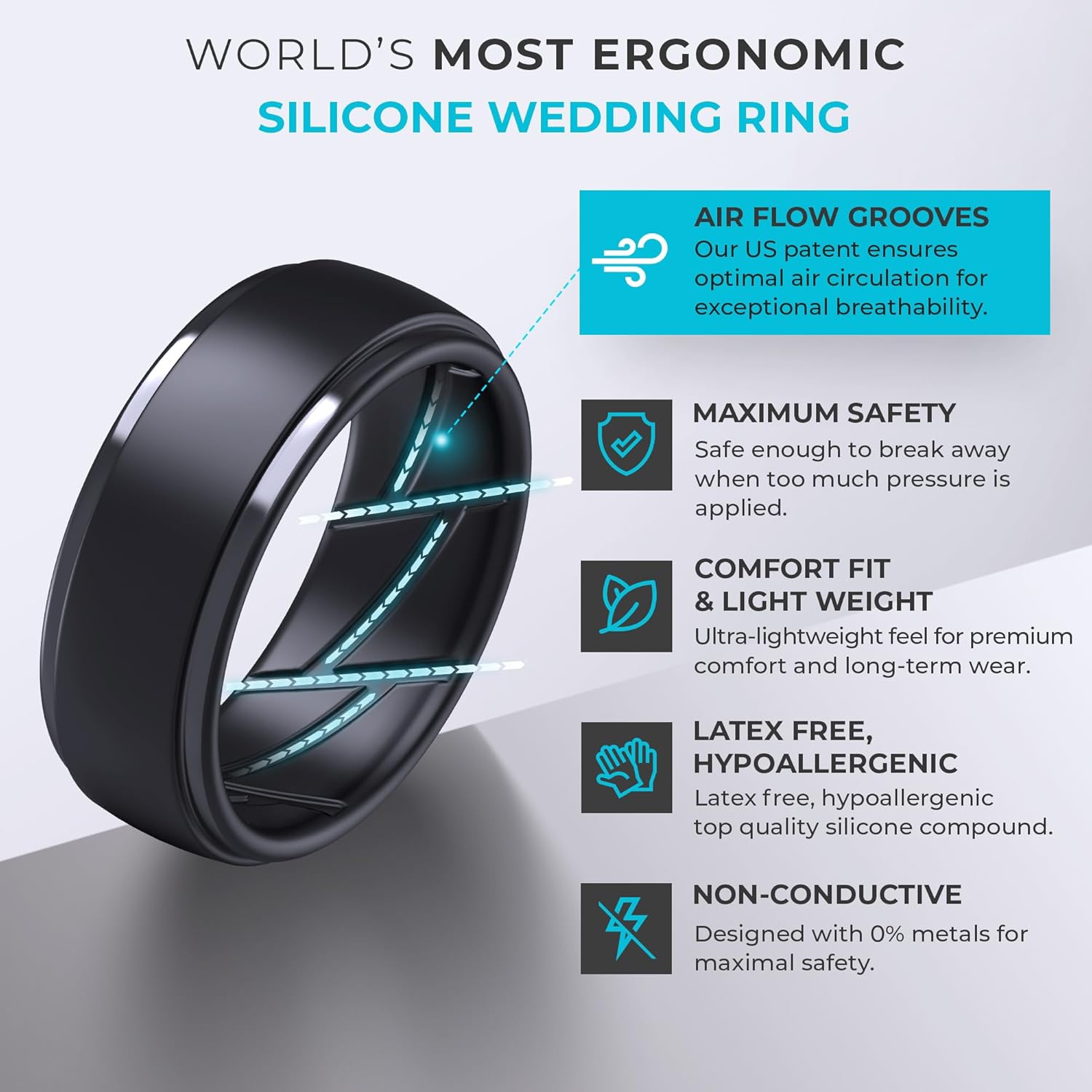
Your wedding band is meant to stay on your finger for life — but there are a lot of days when keeping it there is genuinely dangerous. A ring worn during heavy lifting, surgery, rock climbing, or electrical work can catch on equipment, conduct current, or get crushed against bone in ways a bare finger never would. That’s where silicone rings (flexible, soft bands made from medical-grade rubber) and hybrid rings (bands that combine a silicone base or liner with a thin metal, wood, or carbon fiber shell) come in. They’re designed to be worn when your real band stays in the drawer: they stretch and break away under pressure so they can’t trap or deglove a finger, they don’t conduct electricity, and they cost between $15 and $80 rather than $300+. This guide will help you figure out which type fits your situation, what the real tradeoffs are, and when a silicone ring is a permanent part of your rotation versus a temporary placeholder.
Why “Just Take It Off” Isn’t Always the Answer
The instinct is reasonable: if the ring is dangerous, remove it. The problem is behavioral. Rings come off in gym bags, get left on locker-room shelves, or go missing in surgical scrub sinks. For many wearers — particularly people who work rotating shifts, travel frequently, or simply feel psychologically incomplete without something on that finger — a safe wearable is a more reliable solution than depending on memory and routine.
NIOSH’s Finger Ring Safety fact sheet identifies ring avulsion (where a ring catches on a fixed object and strips tissue from the finger at speed) as one of the most severe occupational hand injuries, occurring across trades, food service, military service, and athletics. The American Society for Surgery of the Hand’s ring avulsion patient education document notes that avulsions range from skin tears to complete degloving or amputation — and that the injury mechanism is instantaneous, leaving no time to react. A ring that breaks away or stretches without gripping is categorically safer in high-snag environments.
Silicone addresses this directly. Medical-grade silicone (the material standard most reputable brands use, sometimes called ASTM D412-compliant silicone) stretches under load and, at sufficient force, tears cleanly rather than transferring that force to bone and tissue. For surgeons and OR staff, there’s an additional benefit: silicone is non-conductive and non-reactive in sterile environments, whereas metal bands must be removed before many procedures.
The tradeoff you need to name clearly: silicone rings are not a substitute for your real band in terms of aesthetics, material prestige, or emotional weight. They’re a tool. The question is whether you need that tool, and how much you’re willing to invest in it.
The Three Buyer Scenarios — and Which Ring Type Fits
Scenario 1: Full-Time Replacement (Budget $15–$35)
Some buyers — particularly tradespeople, emergency responders, and military personnel in deployment — find they almost never wear their metal band. The silicone ring becomes the daily driver; the metal band lives in a box for formal occasions. For this buyer, a plain silicone band in the $15–$35 range is the honest recommendation.
By the numbers:
- Entry-level silicone bands (Enso, Qalo, ROQ): $15–$30 per ring
- Mid-tier with textured or multi-layer profiles: $25–$45
- Hybrid silicone/metal shell rings: $45–$80
- Average replacement cycle (reported by owners across aggregated reviews): 12–24 months with daily wear
At this price point, brands like Qalo (a pioneer in the silicone ring category, per The Knot’s Alternative Wedding Bands guide) and Enso Rings dominate. Wirecutter’s silicone wedding ring roundup consistently names Enso as a top pick for comfort-fit geometry and silicone durometer (hardness) that balances flexibility with enough structure to feel ring-like rather than like a rubber band. Qalo is frequently cited for wider color and style selection, including stackable options that let couples coordinate across two rings.
For this scenario, the decision rule is simple: buy two or three. At $20 each, having a backup in the gym bag eliminates the “bare finger” problem when one gets lost or damaged.
Scenario 2: Rotation Wearer (Budget $35–$80)
This is the most common active-lifestyle configuration — a buyer who owns a real metal band they love but needs something safe for specific contexts: CrossFit five days a week, weekend climbing trips, work in a hospital or trade setting. The metal band goes on for dinners, events, and weekends off.
Here, aesthetics start to matter more because the silicone ring gets worn publicly. The hybrid category earns its place. Hybrid rings pair a silicone interior (which provides the breakaway safety and flexibility) with a thin outer shell of a harder material — typically stainless steel, titanium, carbon fiber, or wood veneer. The result looks like a real ring at a glance while retaining the safety profile of silicone.
JCK Online’s alternative metals trend reporting has noted growing demand in this hybrid segment as buyers seek something that “reads” as a wedding band without the risk profile of solid metal. The tradeoff is durability of the outer shell: carbon fiber and titanium shells hold up better under impact than wood veneer, which can chip or discolor with consistent moisture exposure.
If you’re buying a hybrid, verify two things before purchasing:
-
Breakaway force rating. Reputable hybrid ring makers publish the force (in pounds) at which the ring separates. Look for ratings in the 20–35 lb range — enough to stay on during normal activity but low enough to release under avulsion-level force. Some budget hybrids omit this spec entirely; that’s a red flag.
-
Inner diameter consistency. Because hybrids layer materials, the stated ring size sometimes runs slightly tighter than a standard metal band. Owners across review aggregations frequently note that sizing up by half a step (e.g., ordering a 10.5 if you’re a 10 in metal) corrects this.
Scenario 3: Partner Coordination and LGBTQ+ Matching Sets
For couples designing a full ring system — a metal band for formal wear plus a silicone or hybrid band for daily active use — the coordination challenge is real. Not all silicone brands offer consistent color matching across men’s and women’s sizing, and “women’s” cuts are often narrower and pastel-coded in ways that don’t serve all buyers.
Enso Rings and Qalo both offer collections labeled gender-neutral with consistent color runs across all widths (4mm to 8mm). Couples seeking matching black silicone bands — a popular choice for LGBTQ+ couples and non-traditional buyers, per The Knot’s coverage of non-gold wedding trends — will find the widest selection at Enso and through Groove Life, which also offers customizable hex-pattern textures on the exterior.
The decision frame here: buy the silicone set at the same time as the metal set, not after. Matching color coordination is much easier when you’re selecting both simultaneously, and many specialty metal jewelers (Lashbrook, for example) now offer complementary silicone bands in neutral tones designed to pair with their steel and titanium collections.
Material Spec Deep-Dive: What “Medical-Grade Silicone” Actually Means
The term “medical-grade” is used liberally in product marketing and carries no single enforceable regulatory definition in the ring context. What it typically signals — and what you should verify — is silicone that meets one or more of the following standards:
- ASTM D412 compliance, which governs tensile strength and elongation properties of rubber materials. A ring made to this standard will have predictable stretch and breakaway behavior.
- ISO 10993 biocompatibility testing, more relevant for prolonged skin contact and used in actual medical device silicone. Some premium brands cite this; most entry-level brands do not.
- Nickel-free and latex-free confirmation. This matters for wearers with metal or latex allergies — a meaningful group among buyers who chose steel or titanium precisely because of nickel sensitivity. Pure silicone contains neither, but some hybrid rings with metal shells may use nickel-containing alloys. Verify the shell material spec before purchasing if sensitivity is a concern.
The practical implication: if a brand doesn’t publish the silicone spec or tensile/breakaway data anywhere in their product documentation, their “medical-grade” claim is marketing language rather than a verifiable standard. This isn’t necessarily disqualifying for a $20 ring, but it matters if you’re buying for an occupational safety context.
Sizing, Fit, and the Half-Size Problem
Metal bands are routinely available in half sizes (e.g., 9.5, 10.5). Silicone rings are less consistently so — many brands offer only whole sizes, and the stretch properties of silicone mean fit behaves differently than metal. A silicone ring that feels slightly snug when dry may feel correct after a few minutes of wear as the material warms and relaxes; one that feels right when cold may spin loosely during a hot workout.
Owners across long-run review threads consistently recommend the following approach: measure your finger at end of day (when fingers are at their largest due to mild swelling from daily activity), and use that measurement as your baseline. If you’re between sizes in silicone, size up rather than down — a snug silicone ring on a swollen finger during exercise is uncomfortable and marginally reduces the breakaway efficiency.
For hybrid rings, the additional outer shell material adds approximately 0.5–1mm to the outer diameter without changing the inner fit. Width choice matters here too: an 8mm hybrid will feel more substantial and may fit differently on a 6mm-sized finger than expected. Most brands with live customer service (Enso and Groove Life both have strong owner-reported support ratings) will exchange unworn rings for a different size within 30 days.
The Decision Rule
If you work in any environment where ring avulsion, electrical conductivity, or sterile field requirements are a real factor, a silicone or hybrid ring isn’t a nice-to-have — it’s a practical safety choice that costs less than a dinner out.
If you almost never wear your metal band at work or in your primary activity: treat the silicone ring as your daily driver and the metal band as special-occasion jewelry. Spend $20–$30, buy multiples, and don’t overthink the aesthetics.
If you split time between active and social contexts: invest in a hybrid in the $50–$80 range with a published breakaway rating and a shell material that matches the visual register of your metal band. Carbon fiber or brushed titanium shells read closest to steel and tungsten; wood veneer reads as a different aesthetic entirely.
If you’re buying as a couple: coordinate your silicone selection at the same time as your metal bands. Choose a brand with consistent sizing across all ring widths, and confirm they offer gender-neutral colorways if that matters to you.
Your metal band represents the commitment. The silicone ring represents the judgment to protect both the commitment and your finger — which is, in the end, the more practical expression of the same thing.