April 28, 2026 • Mara Voss • 9 min reading time • Prices verified June 5, 2026
Cobalt Chrome Wedding Bands: The White-Gold Alternative That Actually Holds Its Color
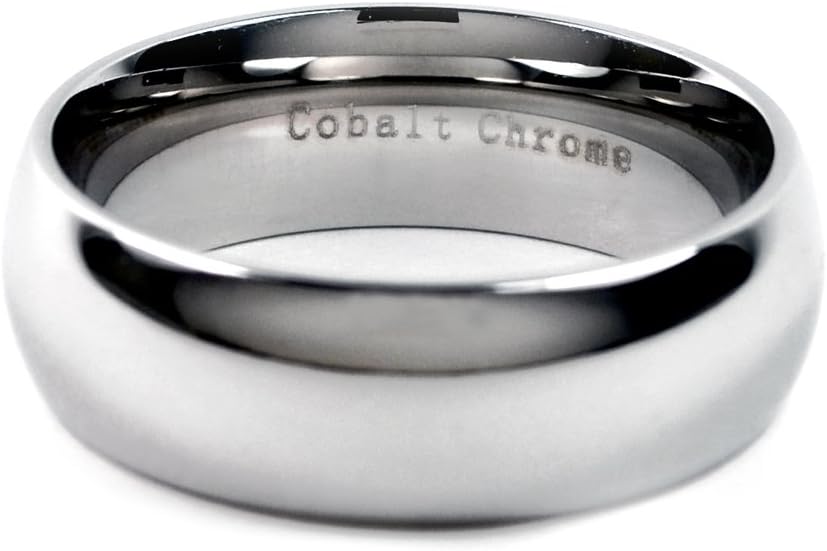
If you’ve been comparing wedding bands and keep circling back to that clean, bright-white look — the kind that reads almost like white gold in photos — cobalt chrome is probably already on your shortlist, even if you didn’t know the name for it yet. Cobalt chrome (sometimes written as cobalt chromium, and sold under brand names like Cobalt by Benchmark) is a metal alloy — a mixture of two or more metals — that has been used in orthopedic implants and aerospace parts for decades because of how extraordinarily hard and corrosion-resistant it is. In the wedding band world, that translates to a ring that keeps its polished finish longer than most alternatives, sits comfortably on the hypoallergenic (unlikely to trigger skin reactions) spectrum, and consistently photographs with a brilliance that other “silver-toned” metals can’t quite match. This guide breaks down the material science in plain language, compares cobalt chrome to its closest competitors, maps out what you should actually spend, and gives you a clear decision rule at the end.
What Makes Cobalt Chrome Different from Other White Metals
To understand why cobalt chrome behaves the way it does, it helps to know the two numbers that matter most in alternative-metal shopping: Mohs hardness and Vickers hardness.
- Mohs hardness is a 1–10 scale measuring scratch resistance. A diamond is 10. Your fingernail is about 2.5.
- Vickers hardness (HV) is a more precise engineering measurement — the higher the number, the harder the material.
Per published spec data from Lashbrook Designs and Benchmark’s material education pages, cobalt chrome typically rates between 8 and 9 on the Mohs scale and lands around 400–500 HV, depending on alloy composition. For context:
| Material | Approx. Mohs | Approx. Vickers (HV) | Color |
|---|---|---|---|
| Cobalt chrome | 8–9 | 400–500 | Bright white |
| Tungsten carbide | 9–9.5 | 1,200–1,800 | Gray-white |
| Stainless steel (316L) | 5.5–6.5 | 160–200 | Silver |
| White gold (14k) | 2.8–4 | 120–180 | White/yellow cast |
| Platinum (950) | 4–4.5 | 125–165 | Gray-white |
The takeaway: cobalt chrome is substantially harder than white gold and platinum, meaningfully harder than stainless steel, but still softer than tungsten carbide. It will scratch — every metal below tungsten hardness will — but owners across aggregated review threads consistently report that cobalt chrome resists the kind of fine surface scuffs that dull white gold within months of daily wear.
What distinguishes cobalt chrome from most competitors is its natural white color. White gold is actually yellow gold alloyed with nickel or palladium and then rhodium-plated (coated) to look white. That rhodium plating wears off in one to three years, revealing a yellowish undertone underneath. Per The Knot’s alternative metals buying guide, this is one of the most commonly misunderstood aspects of white gold: the ongoing replating cost (typically $50–$150 every one to three years, depending on your jeweler) adds up across a lifetime of wear. Cobalt chrome’s white color isn’t a coating — it is the metal itself. There is no plating to wear off.
Cobalt Chrome vs. the Competition: Where It Wins and Where It Doesn’t
If you’re at the decision point, you’re almost certainly comparing cobalt chrome against at least two of the following: tungsten carbide, titanium, stainless steel, and white gold or platinum. Here’s where cobalt chrome has a genuine advantage, and where it genuinely doesn’t.
Cobalt Chrome vs. Tungsten Carbide
Tungsten is harder — meaningfully so. If scratch resistance is your single highest priority and you work in a trade environment where rings take daily abuse, tungsten wins on the numbers. But there are two tradeoffs worth naming explicitly.
First, tungsten carbide is brittle. Because of its extreme hardness, it doesn’t bend under sudden impact — it fractures. Emergency personnel (emergency room staff, firefighters, EMTs) are broadly trained to recognize this: a tungsten ring that gets caught cannot be cut off with standard ring-cutter tools the way gold or cobalt chrome can be; it must be cracked off using vise-grip pressure. Cobalt chrome, while hard, is ductile enough (meaning it can deform slightly rather than snap) to be removed safely in most medical emergencies using standard equipment, per published protocols referenced in JCK Online’s coverage of alternative-metal medical considerations.
Second, tungsten has a distinctly gray undertone at most finishes. If you want the brightness of white gold, cobalt chrome is closer. Side by side in jewelry lighting, owners consistently describe cobalt chrome as “warmer white” versus tungsten’s “cooler gray.”
Cobalt Chrome vs. Titanium
Titanium is lighter — noticeably so. If you’ve never worn a ring and you’re worried about finger-awareness, titanium’s low density is a legitimate selling point. Cobalt chrome is denser and heavier, which many wearers interpret as “more substantial” or “more jewelry-like,” but that’s preference, not a performance advantage.
Titanium is also slightly softer than cobalt chrome, which means it shows surface wear faster. On the other hand, titanium is easier to work with at the bench, which gives designers more inlay and engraving options at lower price points. For couples interested in meteorite inlay or wood inlay at the $150–$300 range, titanium and cobalt chrome often compete directly — titanium sometimes opens up more customization options simply because more specialty shops are tooled for it.
Cobalt Chrome vs. White Gold
The honest comparison: cobalt chrome wins on durability, scratch resistance, and long-term color stability. White gold wins on prestige signaling (for those who care about that), repairability, and resizability. White gold can be resized by virtually any jewelry shop with a standard torch. Cobalt chrome cannot be resized — this is the single biggest practical limitation of the material, and it’s worth treating as a hard constraint before you buy. Lashbrook’s material specifications and Benchmark’s retailer documentation both confirm that cobalt chrome, like tungsten and ceramic, requires an exchange rather than a resize when finger size changes.
White gold is also meaningfully more expensive. A comparable plain-polished 6mm white gold band in 14k runs $400–$800 at most bridal retailers as of mid-2026. A comparable cobalt chrome band runs $100–$350.
What to Expect Across the Price Spectrum
Under $100: The Entry Tier
Mass-market cobalt chrome bands in this range are widely available through Amazon’s jewelry category, Kay Jewelers, and Zales. Published specs on these pieces typically confirm medical-grade cobalt chrome alloy, but finishing quality — edge polish, comfort-fit profile accuracy, engraving depth — varies. Owners in this category frequently report satisfaction with appearance but note that comfort-fit tolerances feel slightly less precise than mid-range pieces. Fine for a budget-conscious buyer who wants the material benefits without the craft premium.
$100–$350: The Mid-Range Sweet Spot
This is where cobalt chrome arguably over-delivers relative to price. Brands like Benchmark and Triton produce cobalt chrome bands in this range with consistent finishing standards, meaningful design variation (brushed, polished, satin, two-tone), and measurable comfort-fit accuracy. Per Benchmark’s published catalog, their cobalt chrome line uses an alloy formulation developed for orthopedic applications, which is a reasonable proxy for consistent metallurgical standards. JCK Online’s bridal alternative-metals coverage has noted cobalt chrome’s mid-tier market position as one of its clearest competitive advantages over platinum alternatives.
$350–$600+: Specialty and Inlay Work
Lashbrook’s cobalt chrome lineup includes meteorite, carbon fiber, wood, and antler inlay options in cobalt chrome bases. The case for cobalt chrome as an inlay base: its hardness protects the inlay channel edge from deforming under daily wear, which is a genuine structural benefit over softer base metals. Brilliant Earth also lists cobalt chrome as a base material for custom-design customers. At this price tier, the cost differential over comparable white-gold designs narrows but doesn’t disappear — you’re paying for craft and material selection, not replating and maintenance.
The Biocompatibility Question
Cobalt chrome alloys are used in hip and knee replacements precisely because of their low reactivity in body environments. The Cobalt Institute’s published alloy properties documentation confirms that standard medical-grade cobalt chrome releases negligible nickel — relevant because nickel sensitivity (a common cause of contact dermatitis from jewelry) affects an estimated 10–15% of the population, per dermatology literature widely cited in jewelry industry guides.
However, cobalt itself can be a sensitizer in rare cases, particularly in alloys where cobalt content is higher than the orthopedic standard. The practical recommendation: if you have a documented metal sensitivity beyond nickel — particularly to cobalt or chromium — get a patch test from a dermatologist before committing. For the overwhelming majority of buyers, cobalt chrome is genuinely hypoallergenic in daily wear. Buyers with confirmed nickel sensitivity who have avoided white gold for this reason specifically will almost always find cobalt chrome problem-free, but it’s worth naming the edge case.
Resizing, Warranties, and What to Ask Your Retailer Before You Buy
Because cobalt chrome cannot be resized, the exchange policy at your retailer is not a nice-to-have — it’s a core part of the purchase. Before you finalize any cobalt chrome band, get clear answers on these three questions:
- What is your exchange window for sizing? Benchmark’s authorized dealers typically offer a one-year exchange on sizing; confirm this with your specific retailer, not just the brand.
- What constitutes a warranty claim versus normal wear? Cobalt chrome is hard but not indestructible — inlay materials (meteorite, wood, carbon fiber) have their own wear profiles and may require periodic maintenance.
- Do you stock half-sizes and wide-width variants for exchange? If you’re between sizes or have a wider band preference, confirm inventory depth before you’re in a sizing crunch.
The Decision Rule
If you’re finalizing the choice right now, here’s the if/then frame:
If your primary aesthetic goal is a bright, lasting white finish without replating costs, and your finger size is stable, and you work in an environment that punishes soft metals — choose cobalt chrome with confidence. The material delivers its core promise with unusual consistency across price tiers.
If you need resizability — young buyers who expect body changes, significant weight fluctuation, or simply want lifetime flexibility — cobalt chrome is structurally incompatible with that need. White gold or platinum remains the correct answer.
If extreme scratch resistance in a trade or outdoor environment is the single top priority, tungsten carbide outperforms cobalt chrome on hardness, but only if you accept the brittleness tradeoff and the gray-tone color difference.
If you want meteorite or carbon fiber inlay work in the $350–$600 range and want a base metal that protects the inlay channel edge over years of wear, cobalt chrome from a specialty shop like Lashbrook is a genuinely well-engineered choice — not just a compromise alternative metal.
The color stays. The finish holds. The math on long-term ownership strongly favors cobalt chrome over rhodium-plated white gold for anyone who doesn’t need a ring that can be resized at a neighborhood jeweler. That’s a specific buyer — but for that buyer, cobalt chrome is the most underrated band material in the current alternative-metals market.