May 22, 2026 • Mara Voss • 8 min reading time • Prices verified June 5, 2026
Black Zirconium Wedding Bands: The Oxide-Layer Science Behind That Deep Matte Black
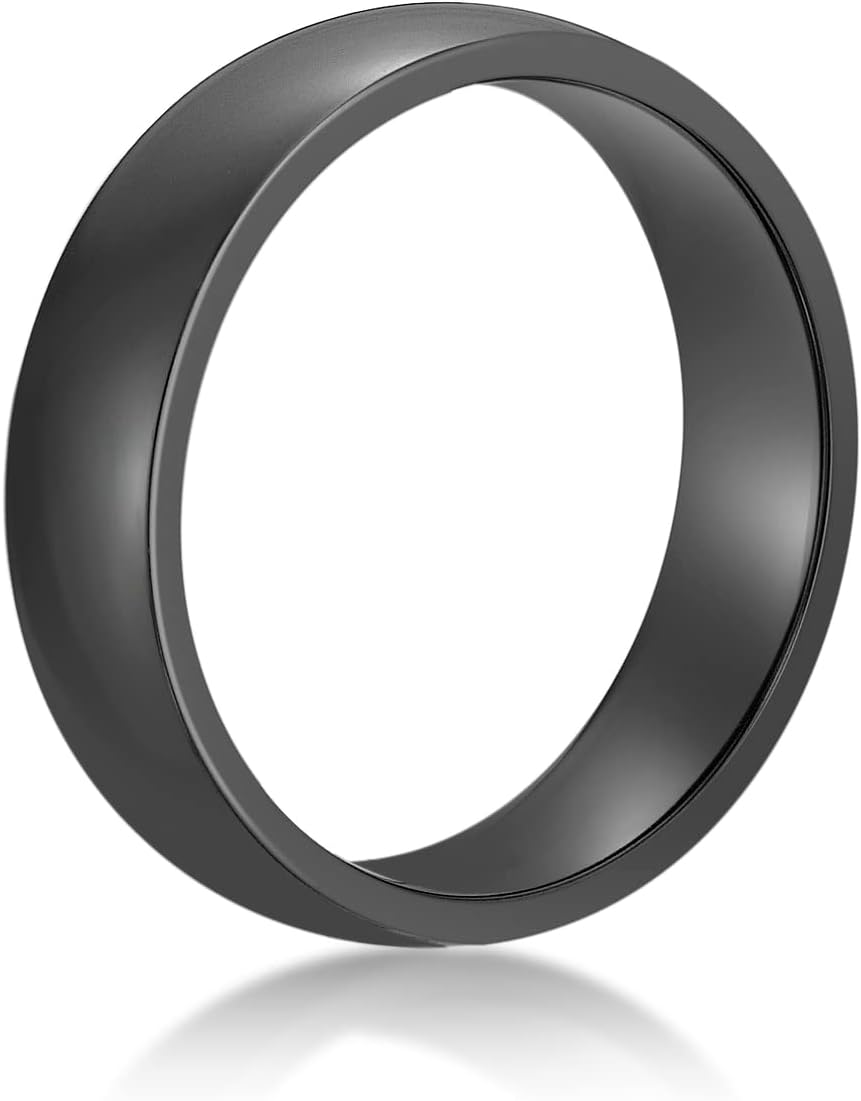
Black zirconium is a real metal — a lightweight, biocompatible element (meaning it doesn’t react with your body and is safe for nearly all skin types, including nickel-sensitive wearers) — that turns a deep, jet-matte black when jewelers heat it to around 900°F. That color isn’t paint, anodizing, or a sprayed-on PVD coating (a thin film deposited in a vacuum chamber, common on blackened stainless steel). It’s a zirconium dioxide layer — technically called an oxide layer — that grows directly out of the metal itself during a controlled oxidation process. Because the black is the metal’s surface transformed, not something applied on top, it behaves very differently than coated alternatives. If you’re weighing black zirconium against black tungsten, black cobalt chrome, or blackened steel, this article will give you the chemistry, the real-world tradeoff map, and a clear decision rule at the end.
| EDITOR'S PICK[The Jewelry Source 6mm Black Zi…](https://www.amazon.com/dp/B0FWMS4D2M?tag=greenflower20-20) | Mid-tierSolid Black Zirconium and REAL… | Budget pick[Metro Jewelry Black Zirconium S…](https://www.amazon.com/dp/B0BL433QK2?tag=greenflower20-20) | |
|---|---|---|---|
| Width | 6mm | 8mm | 8mm |
| Finish | Brushed | — | — |
| Inlay | 14K Yellow Gold Sleeve | Muonionalusta Meteorite | — |
| Comfort Fit | ✓ | — | — |
| Ring Size | — | — | 9 to 11 |
| Price | $442.00 | $219.99 | $29.99 |
| See on Amazon → | See on Amazon → | See on Amazon → |
How the Oxide Layer Actually Works — and Why It Matters
When zirconium is exposed to high heat in the presence of oxygen, the surface atoms bond with oxygen to form zirconium dioxide (ZrO₂). This compound is naturally black in its amorphous (non-crystalline) form when produced rapidly under the right temperature conditions. The layer is molecularly bonded to the parent metal — it’s not a separate material sitting on top, it’s a phase of the metal itself.
What that means in practice:
- The oxide layer cannot peel, flake, or chip the way PVD or DLC (diamond-like carbon) coatings can.
- It is significantly harder than the soft, silver-colored zirconium beneath it. Per published metallurgical data cited by JCK Online in their coverage of specialty bridal metals, the oxide surface of black zirconium measures roughly 8–8.5 on the Mohs scale (a scratch-resistance ranking from 1–10, where diamond is 10 and a fingernail is about 2.5). The soft zirconium core underneath sits at only 5 on the same scale.
- Because the hardened shell surrounds a relatively ductile (bendable, not brittle) core, black zirconium does not shatter under impact the way tungsten carbide does. This distinction is covered in detail below.
The GIA’s gemological reference notes on zirconium in jewelry applications confirm that zirconium’s naturally low thermal expansion and biocompatibility make it one of the more body-safe metals in the alternative bridal space — a meaningful advantage for buyers with documented nickel or cobalt sensitivities.
Black Zirconium vs. the Competition: A Durability Tradeoff Map
If you’re at the decision point between materials, the tradeoffs are real and they cut in different directions depending on how you use your hands.
By the Numbers
| Material | Mohs Surface Hardness | Shatter Risk | Scratch Resistance | Resizable? |
|---|---|---|---|---|
| Black Zirconium | ~8–8.5 (oxide layer) | Very Low | High | No (too hard to size) |
| Tungsten Carbide | 9–9.5 | High | Very High | No |
| Black Cobalt Chrome | ~5–6 | Low | Moderate | No (most designs) |
| Blackened Stainless Steel | ~5.5–6.5 | Very Low | Low-Moderate | Sometimes |
Scratch resistance vs. scratch visibility. The oxide layer resists scratching well — significantly better than stainless steel and cobalt chrome. However, if it does sustain a deep scratch that cuts through the oxide into the silver-gray zirconium beneath, that scratch will show as a bright silver line against the black field. Owners consistently report this as the most visible failure mode, and it’s worth understanding before you commit. Light surface scuffs on the oxide itself tend to blend into a matte finish rather than glint. Per Brides’ overview of black metal bands, this scratch-visibility contrast is the most common complaint from long-term wearers of high-polish black zirconium.
The shattering distinction matters for active wearers. Tungsten carbide’s extraordinary scratch resistance comes at a cost: it is a ceramic composite that fractures under sharp lateral impact. If your hand is caught in machinery or a climbing anchor, a tungsten ring cannot deform to slide off — it will crack, which is the preferred emergency outcome, but the failure mode is abrupt. Black zirconium’s ductile core means the band will deform rather than shatter under extreme force, making it closer to titanium or cobalt chrome in emergency-removal behavior. For surgeons, mechanics, and tradespeople who interact with heavy equipment, this is a non-trivial distinction.
Biocompatibility edge. Cobalt chrome contains cobalt, which triggers contact dermatitis in a meaningful subset of the population (National Jeweler has covered sensitivity claims in the cobalt-chrome segment). Black zirconium contains no nickel and no cobalt. For buyers with documented metal sensitivities, this gives it a genuine edge over both blackened stainless steel (which often contains nickel in its alloy) and cobalt chrome.
Finish Options, Design Latitude, and the Inlay Question
Black zirconium is not a one-look material. Jewelers including Lashbrook and Benchmark — both of whom work extensively in specialty metals — offer the oxide surface in several finish states:
Matte/brushed. The most popular finish, per aggregated retailer data referenced in The Knot’s alternative metals guide. Hides light surface wear best and gives the deepest visual black.
Polished. Creates a mirror-like, almost lacquered appearance. More visually dramatic, but surface micro-scratches are more visible over time on a polished finish than a matte one — the same physics that apply to polished stainless steel.
Mixed/partial finish. Many Lashbrook and Benchmark designs pair a black zirconium outer shell with an inlay — wood, meteorite, carbon fiber, turquoise — visible through a center channel or along a stepped profile. Because the zirconium is hard enough to protect softer inlay materials at the band’s edges, it functions well as a protective frame. Owners of meteorite-inlay black zirconium bands consistently praise the visual contrast between the warm Widmanstätten (the crystalline iron-nickel pattern found in pallasite and iron meteorites, visible after acid-etching) and the flat-black zirconium surround.
Damascus steel with black zirconium elements. A smaller but growing design category, particularly in Lashbrook’s lineup, pairs a Damascus steel (layered, forge-welded high-carbon and low-carbon steels whose pattern is revealed by acid etching) patterned inlay inside a black zirconium shell. This is one of the more visually complex designs in the alternative metal space. JCK Online’s coverage of the specialty metal bridal segment notes Lashbrook as the most frequently cited source for Damascus-forward designs at the $300–$600 price point.
What You Cannot Do: Sizing and Resizing
Black zirconium cannot be resized. The oxide layer will crack under the mechanical deformation required to stretch or compress a band, and the exposed zirconium underneath cannot be re-oxidized to match the original surface in a repair-shop context. This is a hard constraint — not a retailer preference. If your ring size is uncertain, most specialty retailers (Lashbrook included) offer exchange programs for a different size within a set window, and some offer lifetime size-exchange policies. Confirm this in writing before purchase. The exchange policy landscape for alternative metals is fragmented and not standardized; what Lashbrook offers differs from what a mass-market retailer offers. Per National Jeweler’s reporting on the specialty metal segment, exchange policy is one of the leading post-purchase friction points across the category.
Price Positioning and What You’re Actually Paying For
Black zirconium sits in a distinct middle band of the market in 2026.
- Entry-level black zirconium (simple comfort-fit band, no inlay, from direct-to-consumer online brands): $80–$150. At this tier, you’re getting the genuine oxide-layer blackening process and the biocompatibility benefit, but finish quality and tolerances vary. Read return policies carefully.
- Mid-range with inlay or mixed finish (Benchmark, Triton): $200–$400. More consistent surface finishing, better edge beveling, and typically stronger exchange programs.
- Specialty/hand-finished (Lashbrook, Brilliant Earth): $350–$700+. At this tier you’re paying for design complexity (Damascus inlay, meteorite channel, textured oxide patterns), tighter dimensional tolerances, and a retailer relationship with an established warranty structure.
The pricing gap between entry-level and specialty isn’t only about aesthetics. Reviewers and owners who’ve compared both tiers consistently note that edge finishing — how the band transitions from the flat top surface to the inner comfort-fit curve — is where quality diverges most visibly at the $100 vs. $400 price points.
Matching Sets and the Coordinated-Set Buyer
Black zirconium is one of the more flexible materials for coordinated matching sets, and it’s a strong choice for couples who want a cohesive look without defaulting to identical bands. A common pairing: one partner wears a full black zirconium band; the other wears a band with a black zirconium center and a contrasting metal or inlay on the outer edges. Because the oxide surface reads consistently across manufacturers who use the same oxidation process, coordinated sets from a single manufacturer hold color parity well over time.
For LGBTQ+ and non-traditional couples shopping outside the white-gold-and-diamond default, black zirconium’s visual language — contemporary, non-precious-looking, ungendered — makes it a consistently cited favorite in this segment, per The Knot’s coverage of non-traditional bridal metal trends.
The Decision Rule
If you’ve read this far, here’s the clean if/then map:
If you want the deepest, most permanent black available with zero coating-failure risk, and you’re comfortable with a non-resizable band → black zirconium is the right call over blackened steel or PVD-coated alternatives.
If you work in an environment with genuine ring-crush risk (heavy machinery, climbing, construction) and scratch resistance is secondary → consider titanium over zirconium, since titanium deforms more gracefully and is easier to cut off in an emergency.
If scratch resistance is the top priority and you’re in a very low-impact environment → tungsten carbide outperforms black zirconium on that single metric, but you accept the shattering risk and zero resizability.
If metal sensitivity is driving your decision and you want the most biocompatible black band available → black zirconium wins the field outright; it contains neither nickel nor cobalt.
If you’re commissioning a band at $300+ with inlay → go directly to Lashbrook or Benchmark, confirm the exchange/resize policy in writing, and ask specifically about the inlay material’s maintenance requirements before signing off on the design.
The oxide layer is the story of black zirconium. Once you understand that the black is the metal, not a finish on the metal, every other buying decision — finish type, inlay choice, price tier, retailer policy — follows logically from there.